

The Tapestries
The meeting with Jean Luçat in September 1941 sealed Dom Robert's destiny as a tapestry cartoon painter. Dom Robert's woven artwork includes almost one hundred and fifty original cartoons, most of which were woven in Aubusson …
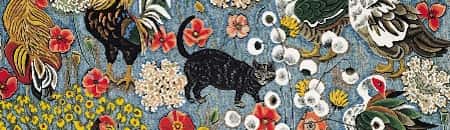
Between 1955 and 1994, some forty were woven in the Tabard workshops, including L'Été (Summer), the first of Dom Robert's tapestries. Between 1955 and 1994, a hundred were produced in the Goubely weaving workshop. Just one work of art, Terribilis, was woven by the Beauvais Meublier National (the French National Furniture and Manufactures in Beauvais) for the Church of Notre Dame in Dijon. Often, several copies were made of each cartoon, and the majority of Dom Robert's tapestries are held in private collections. Tapestries also hang in public and private buildings, such as schools, town halls, and company headquarters, as well as in museums such as the Paris Museum of Modern Art, the art gallery at The Gobelins Manufactory, the Dijon Museum of Beaux-Arts, the Jean Lurçat and Contemporary Tapestry Museum in Angers, the International Museum of Tapestry in Aubusson and the Museum of Dom Robert and 20th century tapestry, opened in 2015.
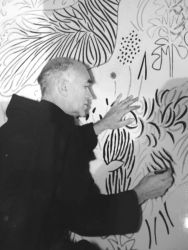
Between 1942 and 1992, Dom Robert created almost one hundred and fifty tapestry cartoons, some of which were extraits from prior cartoons or reworked ones, but always of his own making. Dom Robert adopted the technique of the numbered cartoon developed by Jean Lurçat, and once adopted he stuck to using it.
Dom Robert's first tapestries were based on his watercolors which interpreted the seasons. These were followed by several works commissioned for church buildings such as Terribilis for the Dijon Church of Notre Dame, then Notre-Dame-de-France for the church of the same name in London. In the 1950s, the human figure, present in La Création de l'homme (Creation of Man) and Magnificat, disappeared for good as well as any religious themes. It was the plant and animal world that then captured the artist's attention. The poetic titles, though never illustrative, are, however, highly evocative of this vein of inspiration.
